There is always room for a dozen or so more of our feathered friends at our bird feeding stations and they drop by for a munch several times a day, every day. Today, Doc staggered home with another sack of bird food which will only last a few weeks. We keep the larger stocks in the garage and we also have a bird larder in the utility room. It is full of peanuts, nyger seeds, sunflower seeds and packets of mixed seeds. Sometimes I think the birds are better fed than we are!
We loved to do our bit for wildlife and the birds are very entertaining. Fortunately the squirrels don’t pose a threat because all of our feeders are RSPB approved. However, this does not guarantee peace at the diner because the greedy pigeons do scare off the more timid birds. Yesterday, I saw three black crows hanging off a bird feeder and then a pheasant climbed aboard which was very cheeky. Some birds are definitely more welcome than others and we don’t like the troublemakers getting fat at everyone else’s expense.
But the sight of greenfinches, nuthatches and robins makes up for the thugs. The long tailed tits and blue tits come along en masse and there are often as many as ten at the dinner table. But the bird we love to see the most is the jay. Usually, they are quite shy birds but we see one on a bird feeder now and then and it is beautiful with its characteristic blue flash.
I make bird cake which disappears faster than chocolate brownie in our pantry. I make a dry mix of crushed biscuits, seeds, plain flour and chopped peanuts and pour in some melted lard – about one third fat to two thirds dry mixture. Then I press the cake into metal suet feeders but I always leave a few balls of bird cake on a tray so that the robins can feed. Apparently, they cannot cling on to hanging feeders easily and prefer to peck at the cake on a flat surface. They keep coming back for more so they must like it.
Sadly, I have not managed to get any good photos of the birds feeding but I live in hope. It is a challenge! But as long as the birds have food to make the winter months more bearable, then that is enough for us.
 |
| Springfield Diner |
I spoke too soon. I should not have even thought about mentioning the ‘white stuff’ because it was just asking for a snowball fight, wasn’t it? For there is now a soft, white blanket covering Springfield and the chickens look bemused. So I am spending a couple of days making jam and it is a good way of keeping warm, being useful and keeping off the plot.
We grow lots of fruit so the freezers are well fed throughout the summer. Heavy rain and cold temperatures last summer meant the damson crop failed but fortunately we had some Damsons in the freezer to use up from the previous year!
There are only so many crumbles two people can eat but there are plenty of other delicious things to make. Doc makes Damson (or Raspberry) Gin whilst I concentrate on preserves. We have lots of Damson chutney in the pantry so I thought it was time to make some Damson Jam. I don’t know why some people think making jam is difficult or technical. True, it needs some specialised equipment and you do have to test for setting point, but other than that, it is a case of put the radio on and get on with it. It is a very satisfying occupation and very therapeutic.
Of all the jams, I find Damson the most tedious because of the pesky stones. I don’t like leaving any in, in case someone chokes on one. So I painstakingly remove every single one – and for 3 Kg of fruit yesterday, that was over 400! If I am lucky, I can cut out the stones before the fruit is cooked but sometimes, inexplicably, removing the stones is like extracting teeth so I stew the fruit first, cool it, de-stone it and then heat it up again. Whatever you do, don’t try to remove stones when you have added the sugar because the jam will reach setting point long before you have scooped them all out. Over-boiled jam is like glue and will not spread.
To avoid the stone issue altogether, you can make jelly instead of jam. This is decadent. It is wasteful because you only use juice, not the fruit pulp. I only make it when there is a glut of raspberries or damsons, though I usually make redcurrant jelly every year because it goes so well with lamb and I also add it to braised red cabbage. Jellies are beautiful but they do take longer to make. Stew the fruit and water, mash the pulp and then pour the lot into a jelly bag on a stand, over a large jug. Leave it to drip overnight (never squeeze the bag otherwise you will cloud the jelly) and then for every pint of liquid (568 mls), use 1 lb (454 g) of sugar. Boil as for jam, reach setting point and pot in usual way. The yield is pitifully low but you will have an elegant preserve. If it is crystal clear, you will also impress your friends!
But back to the Damson Jam:
3 Kg Damsons
1.5 litres water
2.4 Kg sugar
Thaw the damsons overnight and remove the stones. If they won’t budge, stew the fruit in a large jam pan with the water for 15 minutes, mashing it with a potato masher to create a pulp. Stir regularly so that the fruit does not burn on the base of the pan. When cooked, cool slightly and remove the stones. Add the sugar, stir over a moderate heat until the sugar is dissolved and then boil rapidly to reach setting point – this can take 15 minutes or it could take 25 minutes depending on the ripeness of the fruit. If a scum forms on top of the jam, spoon it off. Underneath the jam will become dark and bright.
To test for setting point, spoon some jam onto a chilled plate and leave for 5 minutes in the fridge or freezer. Push the jam with your finger and the it should wrinkle. If it is too runny, carry on boiling! Usually you can see a gel forming around the jam pan and with experience you barely need to do a test - though I always do so that I can lick the plate! At this stage, sometimes I add a decent shot of drambuie liqueur but add this carefully as hot jam and cold liquid can cause spurting.
Using a jug and a funnel, carefully pour the jam into hot, sterilised jars and cover with lids. Remember that jam is hotter than boiling water and splashes hurt. At this stage it is very important to line the jars up on the work surface and admire your work. There is nothing like that smug feeling of having a row of sparkly, jam jars. Savour the prospect of having jam sponge and custard. (Though I quite like damson jam on oatcakes.) Invest in some fancy jam jar lids and labels and you have lovely gifts which people really appreciate.
The damson jam is now in the parnty as is the redcurrant jelly. Next, it is the turn of the raspberry. For me, this is the Queen of jams. Use equal quantities of fruit and sugar and if you use frozen fruit which has thawed, you don't need to simmer the fruit for more than a few minutes. This maintains the fruity flavour and gorgeous colour.
Usually, I finish up with little bags of leftover fruits, including blackcurrants and blackberries, so make them into coulis to have with ice cream or make mousses. However, from time to time I make a batch of what I call 'Mixed Berry Jam'. It is surprisingly good and it is important not to waste any fruit.
Enjoy!
After the rush of Christmas and with a new year knocking on the door, the gardening sap is beginning to rise and I have itchy feet and tingly green fingers. I want to eat up the remains of the Christmas cake, sort out my seed box and burn off those excess calories outdoors. I am looking up and down the flower beds for signs of bulbs poking through the soil and scanning shrubs in the hope of finding tight, new buds. I also want to cut down the autumn fruiting raspberries and harvest the rest of the parsnips. Oh, I know there is a long way to go yet (the white stuff!) but I just have to have something to look forward to when the shiny baubles and prickly holly wreaths have been put away.
Yesterday, I headed off down the garden path looking for something inspiring to photograph. However, to quote my Nanna: “Duck, there’s nowt!” Currently, the garden is a truly desolate, dreary place. The ground is as boggy as we have ever known it and the hens will be growing webbed feet soon. There is not even the slightest sign of vigour, colour or interest. And, yes, it is still raining and yes, it still gets dark at 4.00 pm in the afternoon.
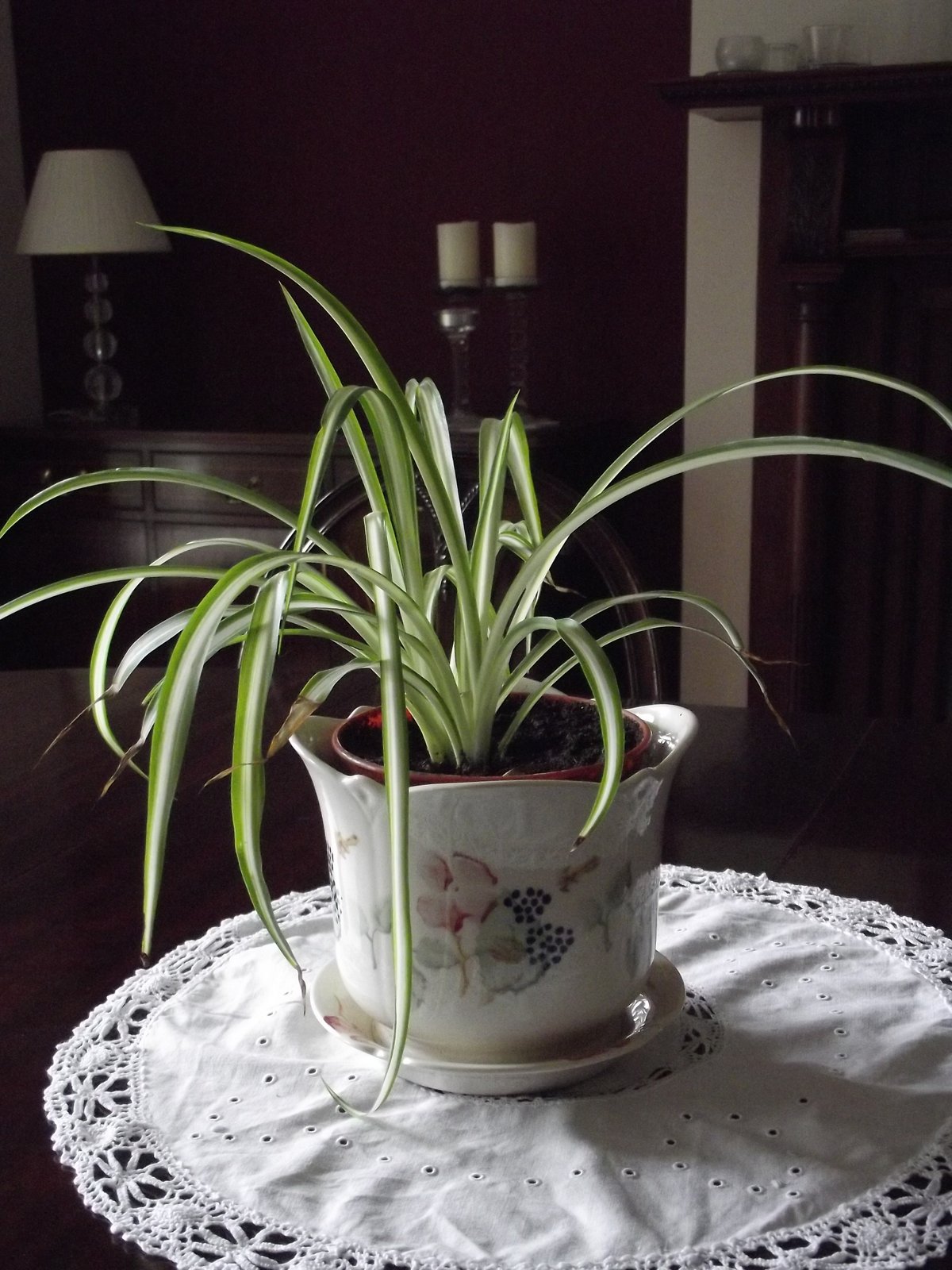
So back inside the house I washed my gardening fleece and gilet, checked my 2013 vegetable rotation plan for a second time and desperation set in. Apart from the seasonal poinsettia and cyclamen (both of which I have kept healthy for several weeks now!) the only thing looking at me was the spider plant.
I loathe spider plants. This one was a mere sprigling in tub of plants given to me as a gift and annoyingly I never seem to be able to consign anything remotely living to the compost heap. I just had to nurture the spidery element, even though it felt like madness. I think, to be honest, I was hoping my attitude to this popular houseplant, might change.
I should feel nostalgic. It was one of the first house plants Doc and I acquired and it was probably the first plant I learned how to propagate. One minute there was a large spidery rosette of stripy green and creamy-yellow foliage and the next there were several spidery babies hanging over the edge of the pot. I dutifully potted them on, gave some to friends and kept the remainder, who in turn produced their own babies, and so it went on. I must have grown on a dozen generations of the wretched plant. They gathered dust, the flowers were so insignificant I nearly missed them and I eventually got very bored indeed. At one stage, Doc did try to perk up one or two of the spider plants with a natty macramé hanging basket but it did not work. For me, the spider plant is a boring plant and is in the same stable as boring rubber plants and boring cheese plants.
Chlorophytum comosum, is possibly the most popular house plant of all time and true, it does have advantages. It is very good at purifying the air in the home by removing toxins and it can tolerate full sun or part shade. A spider plant even dislikes being watered, likes its roots restricted in a small pot and can withstand low temperatures, eg during the night when the heating goes off. But all this does not make me love it, even if it is one of the few healthy, living things around me at the moment.
I am wondering if the best place for the spider plant is in a seasonal arrangement. Maybe I should combine it with some ivy and some colourful spring bulbs. Maybe the spider plant is all about textural interest rather than horticultural prowess and I need to use it more creatively. Can anyone out there convince me it is worth loving? Otherwise I may just have to bite the bullet and creatively put it to good use - in the compost heap where it perhaps can do some good.
A friend said to me the other day that we are nearer to spring than we were in September. I think it was her way of cheering up a gardening buddy. However, we are actually nearer to Christmas than spring and I am still not ‘done’, if you know what I mean. No sooner have I ticked off six items from the top of the To Do list, than another few items appear at the bottom.
I am a really organised person and friends and family think that I have already got my Brussels sprouts simmering away on the Aga. But, I only ever reach Christmas by the skin of my teeth and I am usually panting as I stagger over the finishing line. I don’t listen to the 'Festival of 9 carols and lessons' from from Kings College, Cambridge, with joy, but with utter relief. If by Christmas Eve I don’t have everything, then it is too late. I close the drawbridge, put on a pot of mulled wine and we manage with what we have - which is usually enough to last two Christmasses!
So talking of Brussels sprouts, there always seems to be such a fuss about these ‘little cabbages’ of loveliness. We have sprouts every winter, always at Christmas, and no-one in our family has ever complained or ridiculed this vegetable. In fact, if Doc and I could grow brassicas easily, they would be second on the list after red cabbage. Not only are they delicious but I love the idea of picking our very own harvest for Christmas lunch.
People say Brussels are bitter, boring and they hate the smell wafting from the saucepan. Perhaps that is because they cook them to within an inch of becoming a puree? I don’t put my sprouts on in November for the simple reason they simmer for a few minutes whilst I am dishing up the dinner. And you don’t have to bother putting any criss-cross cuts in the base of sprouts because that lets in more water and they go very soggy. Sprouts should be firm and in our family the dividing line between ‘just cooked’ and ‘dangerous ‘ (ie attempts at stabbing one with a fork results in missile fire) is a fine one.
You can spruce up a Brussels with sautéed pancetta or bacon, shallots or herbs. I am told lemon or even chestnuts are nice with them. Personally, I just simmer them lightly and good gravy does the rest. However, I have shredded them and stir-fried them with other left over veg and that was tasty. They do have an affinity with Chinese or Thai flavours.
So, for me the challenge is to source our sprouts from the vegetable garden rather than the greengrocers. This is what we will have to achieve:
• Sow the Brussels Sprout seed in modules in April and plant out in May.
• The soil needs to be high in nitrogen and limed.
• Sprouts need a sheltered spot as they can suffer from wind rock.
• Plants need to be really firmed in, with a wellington boot.
• They need 5-6 months of growing time, with extra nitrogen feed to prevent the sprouts
from ‘blowing’.
• They also need netting – permanently. Cabbage white butterflies and pigeons are the
two most common pests.
We have got our work cut out if we are going to achieve all of the above. We have acidic conditions and the raised beds are not firm enough for the brassica family to grow well. However, IF Doc starts work on our new dedicated fruit cage next spring, we could move some fruit bushes and use that bed for brassicas!
I feel exhausted thinking about it all. Maybe I am Christmas weary and my energy levels are flagging. I will feel better when I have heard the Kings College choir sing the carols. By the time the first snowdrop appears, I will have found my mojo again and be raring to go on the plot.
When we moved to Springfield nine years ago, Doc was unhappy about packing several boxes of plastic plant pots to bring with us. The removal men didn’t look much happier. When we arrived and started to unpack, they found a coal bunker under a large rhodendron. Doc thought it would be a useful, albeit temporary, home for the plant pots. However, when he fought his way into the bunker, it was full – of plant pots left behind by the previous owners! He was ready to send the removal men off to the council tip but since the plant pots were brand new and square (a very economical use of space on greenhouse staging!) I insisted we add them to our already large collection. I have still only managed to use a quarter of them.
Every gardener knows that plant pots breed at an alarming rate and that is because we encourage them. We buy a plant in a snazzy pink pot and think that the pot will be very useful in the future, when we find something to put in it, which of course we never do. We are told to be thrifty and re-cycle everything in the garden but the trouble is you cannot put plant pots on the compost heap. They gather spiders in the shed, the greenhouse and of course, our coal bunker. They are definitely not an endangered species.
So this year was the year of the plant pot cull because we had reached the point when something had to be done. I tipped out the small flimsies that come from the garden centre and there were several stacks of pots which were cracked, bent or chipped. The tall thin pots which are home to young clematis were also sent to the great pot cemetery as were those shallow pots that don’t allow for any root growth.
The large bucket size pots were much too valuable to throw away. I use those to line decorative terracotta pots because this cuts down on the watering I have to do. Clay pots are very nostalgic so I arranged those on a shelf in the shed - not that I use them very much because they are small and need frequent watering. (I suppose I keep them because they represent the sort of gardener I would like to be, with a dainty collection of auriculars and a theatre on which to display them. This is a fantasy of course because I don’t have time to potter with such frivolities. There are veggies to grow for dinner!)
Doc asked me if I had washed any of the pots and I am afraid this task never reaches the top of priorities. If we had the equivalent of a dishwasher in the shed, I might consider it but life is too busy on the plot for such chores and I don’t have a ‘pot boy or girl’ to help me. If a pot is infested with greenfly I swill it out with water and put it into quarantine - in a pot behind the greenhouse. Should there be anything remotely resembling a vine weevil in a pot, I put it in the dustbin. However, I do often leave pots to sunbathe on the edges of the raised beds. I don’t know if the heat treatment kills beasties and nasties, but this is my theory anyway.
I did a couple of hours volunteering at a local special school yesterday and our leader suggested that it would be very useful if we could tidy up their boxes of pots and throw out the broken ones...... All I can say is that tidying pots in the polytunnel was preferable to working outside in the cold and at least I was recently practised at the task. She also suggested that maybe we could label the shelves with the sizes of pots so the children could learn about volumes. Oh dear, I was a bit rusty on how to ‘size’ a pot. I can identify a litre pot but that’s about it. I tend to pick one up which looks right, don’t you? In the end, we agreed that the labels were best left as small, medium and large.....
Despite Doc’s chuntering about the State Of The Pots, he has come up with a very useful way of up-cycling plant pots. When he planted the new damson tree he had forgotten to buy a plant guard to keep the rabbits off the bark. He very cleverly removed the bottom of a tall plant pot, trimmed the plastic and then curled it round into a collar which fits perfectly around the tree. Secured with plastic wire, it cost us nothing and seems to be working.
Doc has produced a range of sizes and is looking around the garden for other trees and shrubs which may need protection. However, I doubt we need 436 tree collars, which is probably the number of pots in our shed, greenhouse and coal bunker. My cull was not as effective as the tree collar.
Just as I am lamenting about the dearth of fresh produce this autumn compared with other years, my lovely neighbour, Emily, brings a huge bag of apples from her trees. They are not pretty, many of the fruits have scab and all are much smaller than usual. But since we have had no more than a handful of our own apples this year, they are very welcome indeed. When Doc came home from work and smelled apple and cinnamon crumble, Emily was flavour of the week! If she had not already toddled off home, he would have danced a 'Strictly' number with her......
There were a few Bramleys in the bag which are of course the King (why not Queen?) of cooking apples and these are always on top of my list for baking. The rest of the apples were Arthur Turner cooking apples which is also an older variety. This is a heavy cropping apple and it makes a good sauce. It is a also a good baking apple and cooks down to a soft, richly flavoured puree. The ripe fruits do not keep well but they can picked from September through to November. They look attractive too, with blushing pink-brown highlights over the green skin.
Arthur Turner was raised by Charles Turner of Slough. Interestingly, in 1912, when this tree was called Turner's Prolific, it won an Award of Garden Merit for its flowers alone. It was renamed Arthur Turner in 1915, after a relative who sadly died in the first World War.
The fact that Emily's north-facing garden has produced a better crop of apples than our south-west facing orchard, is also interesting. I think it is because we grow different varieties which flower at different times. If a tree flowers and then it rains, the bees cannot pollenate the trees as efficiently. If there are frosts then the fruits cannot set either.
So, if you are planning to grow apples, it is a good idea to grow as many different varieties as you can. Trained cordons, espaliers and fans enable you to grow lots of different apples, very compactly. You also ensure a steady supply of fruits with some apples which can be eaten now and others which will store right through to spring. We have a row of ten, young cordons along the trellis of Mr Macgregors garden. Doc has trained them very successfully but the last two cold winters and this awful summer have slowed down their progress. We are hoping they will come to fruition next season!